Work
Membership is Ownership: A Robust Ownership Verification Framework for Diffusion Models
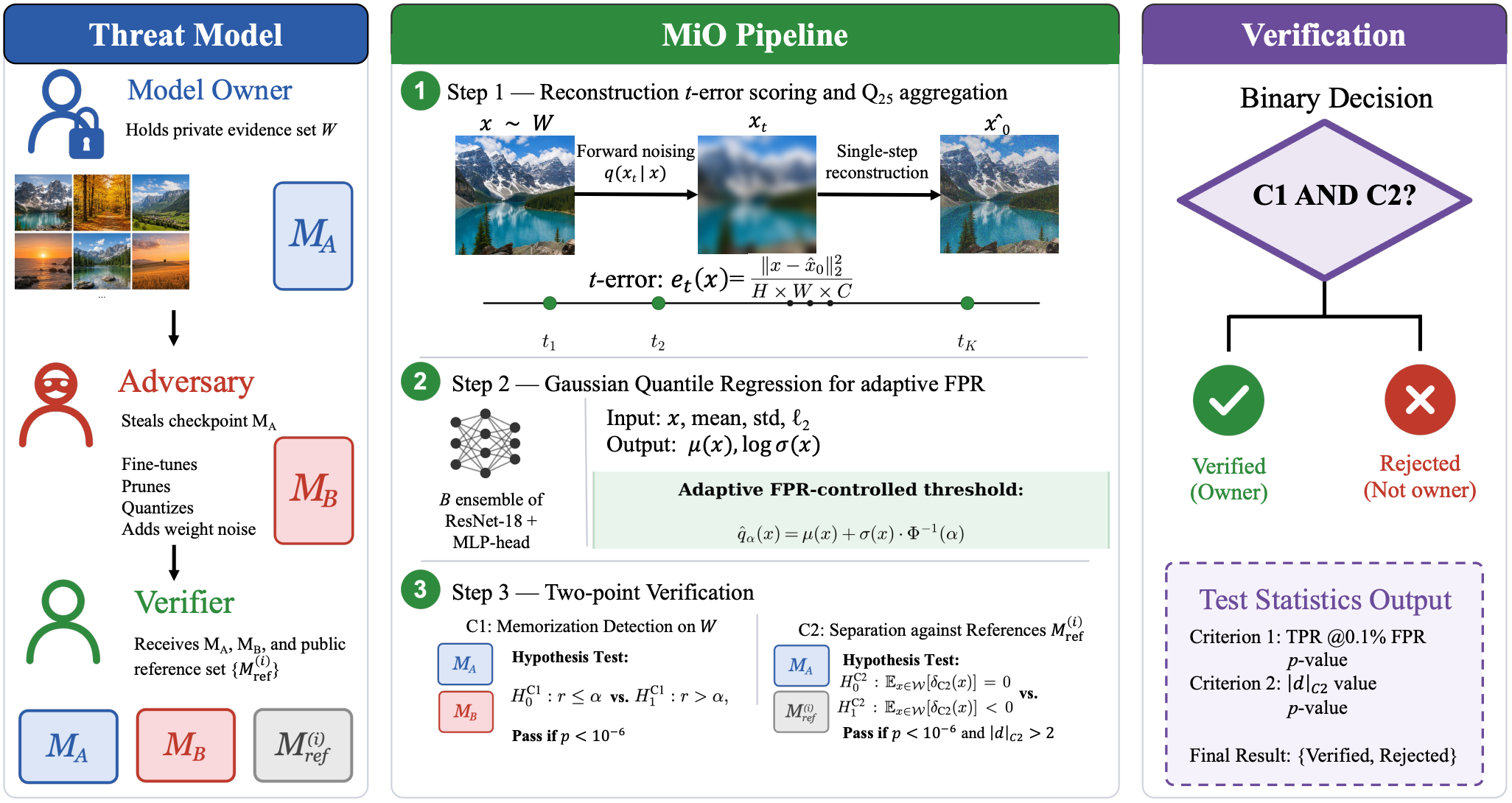
Large-scale diffusion models have fueled numerous profitable downstream applications for AI-related businesses, including visual editing and content creation. Meanwhile, due to the huge amount of resource consumption (e.g., computation and high-quality data) during training, such diffusion models are deemed valuable intellectual property (IP) for tech companies like OpenAI and Google. Yet, the IP assets are vulnerable to various unauthorized uses by adversaries seeking to steal models for customized, usually commercial applications. Some existing approaches explored IP protection for AI models; however, they mostly face structural limitations in common — using a trainingtime watermarking by injecting artifacts in the model, which can impose a measurable utility cost and can be weakened by post-hoc fine-tuning. To address these challenges, this work investigates the IP protection (i.e., model ownership verification) for diffusion models in a realistic commercial scenario with minimal model utility loss. Specifically, the proposed method builds a framework for model ownership verification, termed as “Membership is Ownership (MiO)”, based on a population-level hypothesis test on a private member evidence dataset. Via extensive experiments, the proposed MiO framework outperforms existing baselines in verification success, false positive rate, and mode utility loss. Furthermore, MiO stays stable under different post-theft fine-tuning and weight perturbation in adversarial scenarios, reflecting better robustness compared to the watermarking methods.
A Survey of Machine Unlearning in Generative AI Models
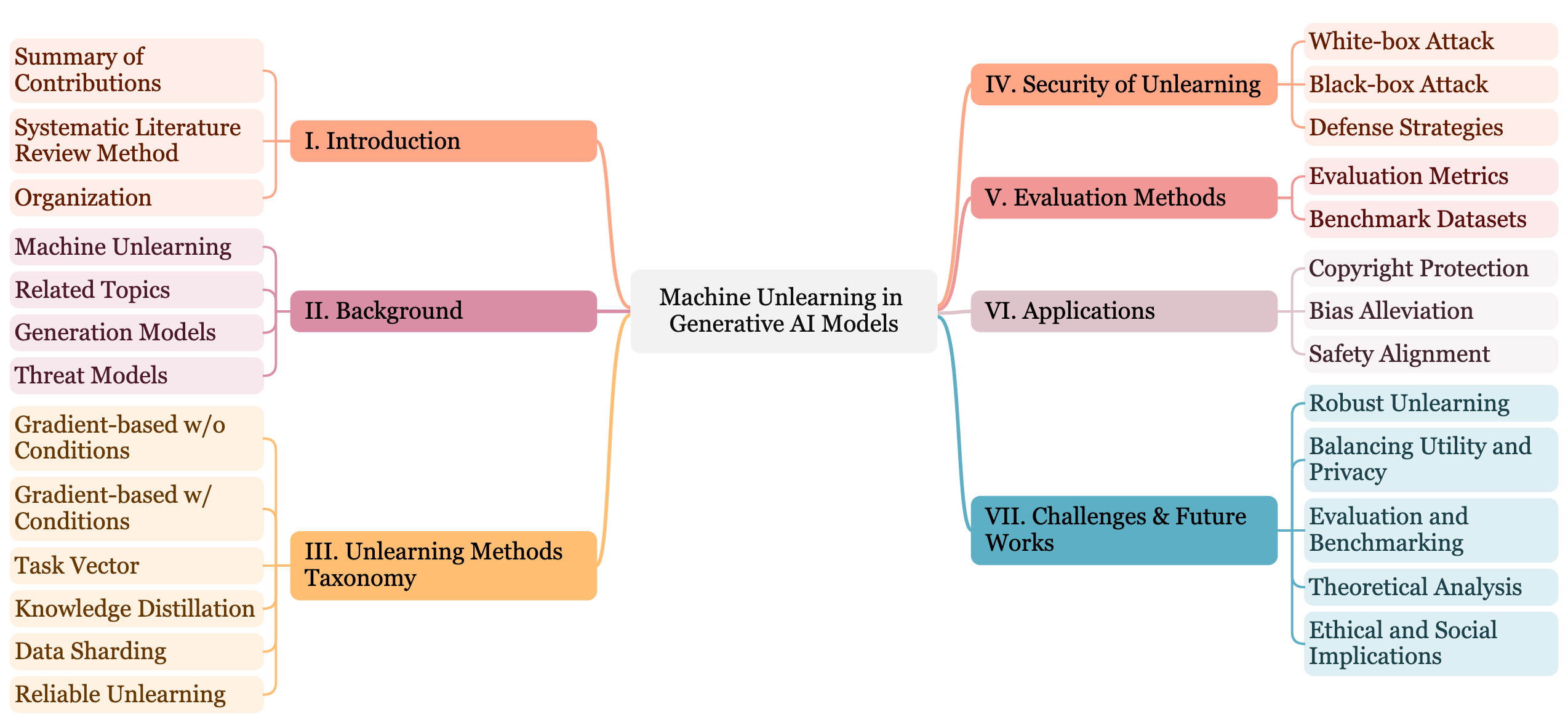
In this survey, anchored in generative models, machine unlearning approaches are reviewed, categorized, and discussed comprehensively and systematically. Existing unlearning approaches are classified into gradient-based techniques, task vectors, knowledge distillation, data sharding, and reliable unlearning methods. Apart from previous works, this survey extends the review of attack methods that aim to exploit the vulnerability in generative models and assess the robustness of these unlearning methods. In addition, popular metrics and datasets in machine unlearning research are summarized and evaluated based on effectiveness, efficiency, and security. Finally, we shed light on the future directions of this emerging research topic by discussing applications, highlighting challenges, and exploring research frontiers for the current machine unlearning community and the new investigators to come.